



In late 2003, Bryan Miller wandered into a hole-in-the-wall restaurant in Jupiter and sat down for lunch. Tired of the local restaurant scene, Miller was on the hunt for something different. He found it at Little Moir’s Food Shack. “Little Moir’s Food Shack looks as if a raucous Key West bar had been uprooted and trucked up north,” wrote Miller—a New York Times food critic—in the newspaper’s January 11, 2004, edition. “Not only is this the coolest place I visited, but it’s also among the best.”
The article launched the then-2-year-old restaurant into nationwide fame; the local surfers’ hangout soon became one of the most sought-after dining experiences in northern Palm Beach County. “It was an unbelievable time,” says owner Michael Moir. “We had lines down the street, 100 people waiting in line. It just took off. It was really fun.”
Now—over two decades later—Moir and his business partner, Drew Shimkus, are still having fun. This month, the duo will open Sweet Fish, the latest restaurant in the growing Little Moir’s portfolio of Jupiter-based businesses, including restaurants Food Shack and Leftovers, live music venue Maxi’s Lineup, and seafood market and catering hub Hibiscus Streatery.

For Moir and Shimkus, who both started working in the restaurant business as teenagers, success is all about keeping it fun and fresh. Originally from Toronto, Canada, Moir was 14 years old when he got his first job at the Duchess of Markham restaurant as part of a school program. “I went in and met the chef. He asked me to pick up a garbage can. I picked it up about one inch off the ground, and he told me I had the job. It was a low bar,” laughs Moir. He was put to work washing dishes and peeling vegetables, and was quickly promoted to salad prep and pasta making. “I fell in love with the business,” he says. “I loved the energy, the team, and the camaraderie.”
At 18 years old, Moir found himself in culinary school and dreaming of owning a restaurant with live music when he landed a job at Sutton Place, a five-star hotel known for its famous clientele like Rod Stewart and Marlon Brando. “We had a chef’s table, we flew herbs in from France, we hosted a film festival. We had the first live-in butler in North America. It was unbelievable,” says Moir. He worked his way up the line, eventually earning the position of butcher.
In 1991, Moir got a call from Ross Matheson, the owner of the Duchess of Markham. Matheson had opened Captain Charlie’s Reef Grill in Juno Beach and he needed help. “He was having problems with the chef and asked if I would come down,” says Moir. “I was 21 and thought: ‘Beaches? Bikinis? Yeah, I’ll come to Florida for a few months.’” A few months turned into a few decades. The move would also open the door for Moir to meet his future business partner.

Like Moir, Drew Shimkus got his first job in a restaurant at 14 years old. “I always wanted to be a chef growing up cooking with my grandmothers,” says Shimkus, vice president of operations and partner at Little Moir’s. “It’s the only thing I ever thought about doing.” The Palm Beach County native went to work at Charlie’s Crab in Palm Beach—but lost the job when the owners found out he was too young to work there. A friend of Shimkus’s father knew Ross and got him a job at Captain Charlie’s Reef Grill, where Moir was then the head chef. “I started off as a bus boy, but I kept telling Mike I wanted to work in the kitchen,” says Shimkus. “Mike put me in a little room chopping onions and peppers and peeling shrimp to see if I really wanted to work in the kitchen. It was kind of like his garbage can story.” Shimkus was soon promoted to the pantry, where he set up appetizer plates and salads.
Shimkus left the restaurant in 1999 and worked stints as a server and in the kitchen at Testa’s in Palm Beach, Chuck and Harold’s in Palm Beach, Carmine’s Ocean Grill & Sushi Bar in Palm Beach Gardens, and Thirsty Turtle Seagrill in Juno Beach. He reconnected with Moir a few years later. “I ran into Mike on my twenty-first birthday and he told me he was opening a place. He said he would love for me to come work for him, but he didn’t know if he could pay me,” laughs Shimkus.
The new place was the Food Shack, a concept Moir had formulated after leaving the Reef Grill in 2001 and backpacking to Asia and Australia for four months. “I was working 70-hour weeks and I was fried,” says Moir, who traveled to Thailand, Singapore, Indonesia, Australia, New Zealand, and Fiji, eventually making it to Hawaii with an empty bank account and a renewed passion for starting his own restaurant.

The concept for Food Shack came from a picture he took on his trip. “It’s a picture I took in Bangkok in an alleyway of three huge pots and four little stools. The people have their rice and their chilis and all this stuff,” says Moir. “I made the name Food Shack from that picture.” Moir’s concept was unique in Jupiter. “I wanted to do something against the grain. There is a lot of money around here, I wanted to do something like I had in Thailand, a place where you could get the best food in the most unexpected little shacks.”
He leased the current location in a Jupiter strip mall, put up some decorations, built some tables, and opened for business. “I made the menu way in advance, but nothing was tested. It wasn’t well thought out,” says Moir. Adds Shimkus: “We opened the doors and kind of figured it out as we went.”
The plan (or lack thereof) worked: customers showed up and kept coming back. “They wanted us to succeed,” says Shimkus. “They loved the food and they wanted to be a part of something.”
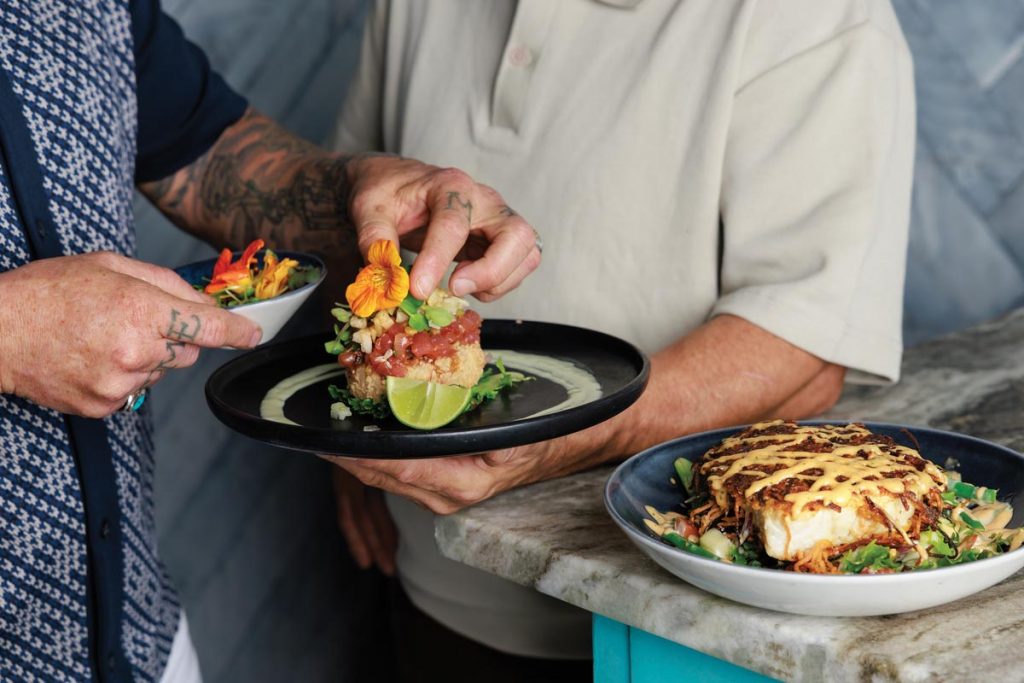
When the duo opened their second restaurant, Leftovers Cafe, in 2008, customers once again showed their love. “The day we opened we had to shut down because we were so busy,” says Moir. “We had 150 people in line and we just took off.”
The secret sauce in the success of both restaurants is the unique culture Little Moir’s has built in its kitchens. “I read an article about cartoonists and about how they would sit around and brainstorm and then they were allowed to freewheel do cartoons,” says Moir. “I thought that was a wonderful idea for our chefs—come in with lots of fun, creative ideas and stay fresh.” Shimkus says they promote creativity every day. “We give our chefs the freedom to express themselves with food.” Customers can expect to see different menu items created by different chefs every time they come to a Little Moir’s restaurant.
Moir and Shimkus are also attuned to what their customers want. They opened Maxi’s Lineup next door to Food Shack in 2010 to help with the overflow of customers. “We were losing a lot of business. People would drive by and see a line and not come in,” says Moir. Live music also attracted new customers. “The clientele had started to get a little older,” says Shimkus. “When we opened Maxi’s, we started seeing all the surfers coming back again.”

Their customers also rely on them for the freshest seafood. So, in 2012, they made a pivotal shift in their fish sourcing. “We decided to stop buying filleted fish from companies and get a fishing license so we could buy from local fishermen,” says Moir. The company needed a place to cut the fish and also a home for its growing catering business. That’s why, in 2017, Moir acquired a property on Hibiscus Street in Jupiter. Hibiscus Streatery, a small fish market and dining room in the front of the building, opened in 2019. The fish market is now expanding into a full market, and the dining room and its staff have moved west to Sweet Fish in Chasewood Plaza off Indiantown Road.

Sweet Fish is designed to evoke an often-forgotten part of Florida. “A big part of Florida we forget about is the western part of the state with cypress trees where the alligators hang out,” says Shimkus. “We wanted to represent that.” The menu is 80 percent seafood and features dishes like sauteed fish, lobster empanadas, fried fish and grits, and succotash. “Many of the dishes there you wouldn’t be surprised to see on the special menu at Food Shack or Leftovers,” says Shimkus.
Many team members at Little Moir’s have been with the company for years, a testament to the culture Moir and Shimkus have built. “Some of our people have been with us since we first opened,” says Moir. “We are blessed to have an amazing team. They make us who we are.”
What’s next for Little Moir’s? Moir and Shimkus admit they don’t know just yet—but this duo is never short on ideas. “My dream restaurant would be doing Food Shack in St. Maarten on the beach,” says Moir. Shimkus has a different concept. “I would do an old railroad dining car in the mountains with a garden behind it,” he says. One thing is for certain: whatever these chefs cook up next is sure to be delicious.








Facebook Comments